Tag: Photography

North East Walks: Crawley Edge

Gary Richardson, Darlington-based freelance photographer and writer, details the North East’s best walks. This month, he’s visiting Crawley Edge…

Route Info:

6¼ miles/10.0 Km with 800 feet/240m of ascent
Maps: 1:25K OS Explorer 307 or 1:50K OS Landranger 88
Start: Durham Dales Centre. Grid ref: NY995392 …. Post Code: DL13 2FJ
Parking: Durham Dales Centre car park.
Where to Eat and Drink: Durham Dales Tearooms, 9.00 to 16.00 Tel: 01388 527650

Route Map

A lovely autumnal walk combining riverside strolls along the wooded Stanhope Beck and Shittlehope Burn valley’s, with an airy walk along Crawley Edge, which gives outstanding views over Upper Weardale. The walk starts in the market town of Stanhope in Upper Weardale.


Leave the car park and go left along the main road, and walk into the market place. Cross the road and go left down ‘The Butts’ heading towards the river. At the bottom of the road, turn right onto the riverside path, which is followed upstream to the Stanhope Swimming Pool. Turn right past the pool to the main road, go left for a short distance, then go right along a track leading to Stanhope Hall (A).


Go right along this and follow it as far as the footbridge across the river. Don’t cross this, but keep on the west side of the stream and follow the path, initially fenced along field edges and then into the woods. Continue through the woods until another footbridge is reached. Cross this and climb the steep steps to join a wide track. Go left along this, through old quarries to reach some derelict mine buildings (B).

Just after passing a large single storey building on the right, take the track going uphill on the right following a wall through gorse bushes to reach a gate. Go right along the track which is followed through Heathery Burn to reach a road. Go directly across the road to reach an old mine track, turn right and follow this downhill. At the buildings go left and then leave the track. Follow the grassy track on the right alongside the wall/fence to reach a gate. Go left along a path through the heather onto Crawley Edge, and continue to reach a fork in the path (C).

Keep straight on along Crawley Edge to reach a road, then turn left uphill to a farm. Go left through the gate and then keep right to pass behind the farm. Find the stream and follow it downstream. As the woods are reached, cross the stream again and follow the path to reach a footbridge. Cross the bridge and go right downstream, following the path through the woods until the next bridge across the stream (D).


Cross this then cross the stile into a field. Keep right alongside the wall to a lane between houses. Go along this, then turn left along Woodcroft Gardens to the main road (A689). Turn right and follow this back through Stanhope to the dales centre.


For more of Gary’s work, visit www.garyrichardson.me.
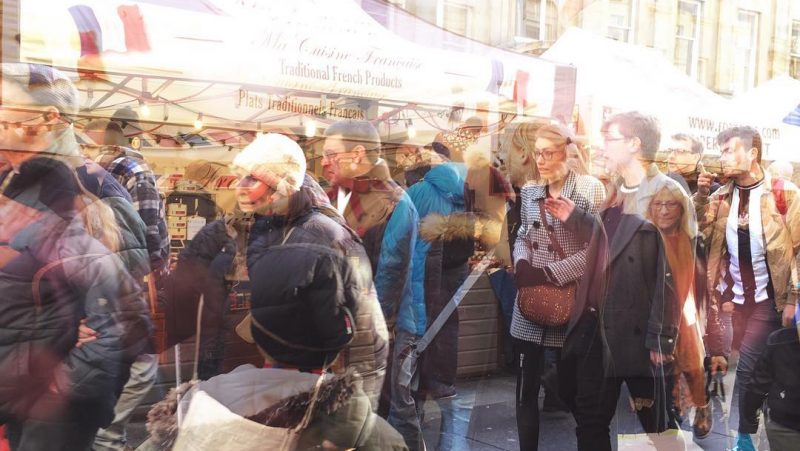
Alternate Reality: Photographer Jo Pattison Captures Street Life

North East Photographer Jo Pattison shares five photographs from her series ‘Alternate Reality’…

As a self-taught photographer, I’m constantly exploring new techniques and looking for new ideas to try out. I’ve never attended any college or university courses to learn photography, and as such I feel I’ve searched for and found my own style, inspiration, and areas of interest.

I don’t have a particularly long attention span, so one of the things I love about photography is that there’s always something new to try, and always something different and unique, whether it’s using a film or a digital camera, trying different filters to achieve new effects, or using different settings on the camera.

One area of photography that particularly interests me is street photography. There are so many fascinating moments that are never caught on camera, so I try to catch them.

I’m drawn to using a slow shutter speed for my street photography, which achieves intentional motion blur. I feel that this captures the hustle and bustle of people rushing about their everyday routine, and beautifully portrays the passage of time, and the way that buildings and streets will remain long after people are gone.

For me, using a slow shutter speed adds a whole other dimension of interest to my photographs. You can almost feel the movement of the scene.


To explore more of Jo’s photography, you can visit her website here.

Dr Twist: Reviving Traditional Sepia Portrait Photography

Charles Twist and Caed Parker are bringing classic portraiture back to life with their traditional, hand-crafted approach to photography. Read on for their story in their own words…


Started by photographers Charles Twist and Caed Parker in 2014, Dr Twist’s Photographarium offers the experience of traditional photography, creating beautiful and timeless, sepia portraits.

Our big plate cameras are fitted with historical lenses, some as old as the 1850s, and are perfectly complemented by a Victorian developing process which delivers real sepia prints. The resulting images have a quality and charm that is not easily mimicked by any modern methods, and along with the physical feel of the print (like a vinyl record over an mp3), the photographs possess a unique presence and character.

The experience transports you to another world. Sitting for a plate camera is a luxury to be enjoyed slowly, and is a process that involves both the photographer and the sitter. This interaction translates in to a portrait that is both warm and truthful.

We bring with us an assortment of vintage props and accessories. Some are genuinely old, while some are quality, modern counterparts. The costumes add great depth to the portraits. Plus, they’re great fun!

A common misconception is that the sitter must remain still for long periods. In reality, while composing the picture can take a few minutes, you only have to stay steady for half a second. We’ve even photographed children and animals with great success.


The plates are processed on site in our specially constructed darkroom. Small and self-contained, it is the modern equivalent of the erstwhile developing carts which would have been used a hundred years ago, allowing the studio experience to travel to your home (or the beach!). Ours is designed so that the whole process is on view. You can look in and see your plate go from a blank sheet of paper to a one-off sepia portrait in the space of a few minutes.

Witnessing this in our modern digital world conjures up a by-gone age when things happened slowly and deliberately. It is enthralling and educational in equal measure.

Each print is totally unique. The piece of paper which is processed in our darkroom-on-wheels is the self-same sheet that is exposed in camera and later handed to the sitter. There are no other copies, no negatives, and (of course) no digital files. The portrait is as unique as an original pencil drawing – quite a rare occurrence in photography, and one that gives the portrait very strong, personal value.

Quite apart from that, nobody else offers this service in this country (maybe even in the world), making it even more special!


We’re available for private sittings to create stunning sepia portraits of your family, your children, your pets, your home, your friends. It may be for a special occasion – a birthday, a wedding, a christening, an anniversary, a Christmas party – or simply because you like to know that your portrait has been created with love and care in the traditional, hand-crafted way. A unique print makes a perfect memento of an important day.

With Christmas coming up, a studio session would create original entertainment at your party, at home, at the pub or at the office. Each guest would sit for a portrait that they could take away on the day. A unique sepia portrait is a great gift which tells your family, friends and colleagues how much you value their companionship.

A sepia portrait of the children or the family is also a brilliantly original Christmas present for the grandparents. In this circumstance, we encourage people to be photographed without our props and accessories, simply because the prints are so beautiful and charming in themselves. Pet photography is also a favourite. Our portraits reveal your furry friends at their best!

We’re also hired by businesses and event companies to entertain on their special occasions – a launch, an important visit, a conference, an office party, a festival. Our portraits are impressively presented in card mounts which we can personalise with your company logo.


Dr Twist’s Photographarium is ideal for a range of periods from the 1880s to the 1940s, and for a range of styles, such as Victorian and Art Deco, to Steampunk. We can modulate our setup to adapt itself to your circumstances. We can even prepare your very own painted backdrop!


Would you like your own unique sepia portrait? You can find more details on Dr Twist’s website, follow them on Facebook, or email them at info@drtwists.com.

Want to discuss your portrait further? Call 07975 945 884 for Charles, or 07738 740 160 for Caed.

Dr Twist’s Photographarium
30-32 Marske Road

Saltburn-by-the-Sea
TS12 1QG

All images are copyright of Dr Twist’s Photographarium, except DrTwist_Festival.jpg which is copyright of Tracy Kidd. This image shows Charles Twist (left) and Caed Parker (right).

The images may only be used with our permission.

North East Walks: God’s Bridge

Gary Richardson, Darlington-based freelance photographer and writer, details the North East’s best walks. This month, he’s visiting God’s Bridge…


Route Info:

7.5 miles/12 Km with 630 feet/190m of ascent
Maps: 1:25K OS Outdoor Leisure 31 or 1:50K OS Landranger 92
Start: Bowes village. Grid ref: NY995135 …. Post Code: DL2 9HU
Parking: small parking area opposite the village hall.
Where to Eat and Drink: The Ancient Unicorn Inn, Bowes village. 01833 628321

Route Map

An interesting walk around through the River Greta valley, which before the local government reorganisation in 1974 was part of North Yorkshire, but now is part of County Durham.

The walk makes use of the two sections of the ‘Bowes Loop’ on the Pennine Way. The first half, over the bleak remote heather covered Bowes Moor, is in stark contrast to the return leg which follows, for most of the way, the wild flower meadows along the banks of the River Greta.

The walk starts in Bowes village, located a few miles south of Barnard Castle, alongside the busy A66 trans Pennine road.


From village hall car park head west straight along main street through village. Just after passing Dotheboys Hall, which features in Charles Dickens novel Nicholas Nickleby, turn right with the road to cross the A66 and climb up to Clint Top. There are good views over the Greta valley from here.

Continue along road passing through remains of an old military storage site, where the foundations of many bunkers can still be seen. There are plenty of warnings signs advising of unexploded bombs and poisonous gas. Don’t worry! It’s years since this site was used, and as long as you stay on the road, there will be no danger.

After about 1.5 miles you will reach the isolated farm of West Stoney Keld (A).


Here go through gate in stone wall, and then leave Pennine Way by turning left and take rough vehicle track heading SW towards Ravock, at first following the wall on the left. Where this track makes a sharp right turn, go straight ahead to follow a faint path through heather which is waymarked with posts and cairns, to reach a boundary stone (B).

Even though there is a faint path, in poor weather/visibility this section of the walk could require the use of map and compass.


Keep on across the heather moor and after about a mile another wall is reached. Turn right to follow it west to reach the other branch of the Bowes Loop on the Pennine Way, close to the farm buildings at Pasture End. Turn left and follow the track downhill towards the busy A66.

Luckily there’s no need to risk your life having to cross this, on reaching the fence beside the road, go to the right to find an underpass. Go through this and go left over the fields, following the track downhill to God’s Bridge (C).

This is a natural limestone bridge over the River Greta. The river bed is usually dry, as it runs underground, as is common with lots of rivers and streams in limestone areas.

Leave God’s Bridge by going through gate in wall to find a new graded track through the fields (a permissive path not shown on OS map). This takes you through the meadows along banks of river, past East Mellwaters to footbridge over Sleightholme Beck at West Charity (D).


After crossing bridge, go left across the field to reach a track. Go right along this and pass through yard of the farm. The track then turns left and heads through fields towards Lady Myres. Pass through farm and continue on track to reach a finger post. Turn left and head across field to reach footbridge over River Greta.

Cross this and climb to Swinholme where a lane is joined heading back towards Bowes. There are good views of the castle from here. Upon reaching a stile over the fence on the right you have a choice of routes. Either follow Pennine Way over the fields to Bowes Castle and back to the village, or follow the stream (right) downhill through the field to reach River Greta again.

Turn left and take the path downstream to reach the lovely waterfall of Mill Force. From there take the path heading diagonally uphill across field to walled lane, and follow it uphill to reach lane close to church and castle. Turn right and follow this lane back to car park.


For more of Gary’s work, visit www.garyrichardson.me.

ADVERTISERS