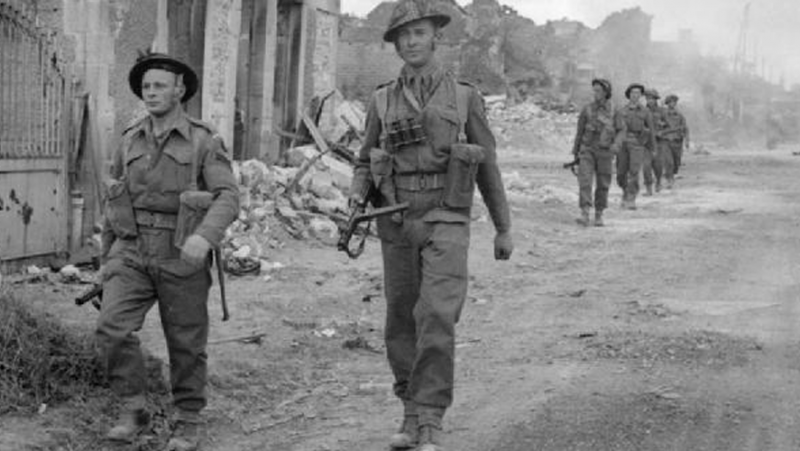
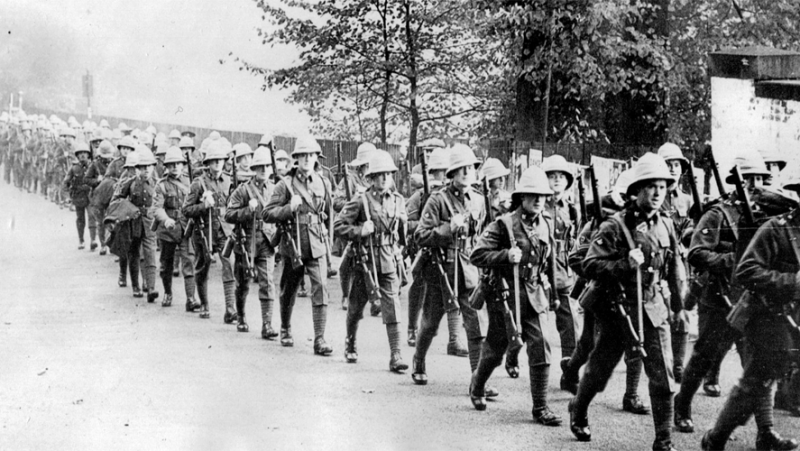
On 21st October, it was announced by Durham County Council that the DLI Museum, honouring the memory of the Durham Light Infantry, would be closed. Deryck Collins tells the story of his own connection to the men who fought…
When I first visited George and Dorothy Clark’s Sunderland home, a framed photograph of a young lad with curly hair caught my eye.
Knowing my interest in military history, they told me, “That’s Worth. He died in the First World War, only sixteen. He was torpedoed on the return leg of his maiden voyage from Boston to Liverpool.”
My wife interrupted quietly to say, “It was his brother Billie I always fancied. It quite amused my granny – his sister – but he was gorgeous!” A couple of photographs of a handsome young man in his early twenties were passed to me. “He died as well, first day of the Somme. His fiancée Dora never married, even after she emigrated to Canada, but she kept in touch with the family. I used to get a pair of furry slippers from her every Christmas until she died.”
I had obviously touched on a very sad, though very dear family story. I was intrigued. It was the first time I had spoken to someone with such a tangible link to the First World War.
As it turned out, Billie’s sister had kept a few keepsakes of him, including the ‘Dead Man’s Penny’, the giant medal presented to the families of all fallen servicemen. They even still had the official scroll that had accompanied it. It had the usual phrases about duty and death, but the line that stayed with me was: “Let those who come after see to it that his name be not forgotten. Cpl William Worthington Wilson Durham L. I.”
Most incredible, I was shown his final letter home. Within were words in his own hand about people that I knew personally; his sister Nellie and brother-in-law Jim, and their newborn daughter (my mother-in-law Dorothy Clark). The letter pulled me in. It was as if the postman had only just delivered it…
21/3/16
My dear Nellie,
As you said in your most welcome letter (received in Egypt), it is just as well I know you. The cap fits us both however, for I’m sure that if you did not know me, you would long since have been thinking some very hard things about your soldier brother. But as that is not the case, if when we both regard letter writing as more or less of a bore, then there is not much harm done by any lack of correspondence on our parts.
Thoughts however are different, for since I commenced my one and only sea voyage till now, there seems to have been a great change come over us, and I’ve realised what you have been, and are now to us a real sister. Now there is Dorothy, many are the times I’ve had your photo out, and felt the better for it. The tales I hear of her canny way and loveable manner make me feel quite eager for the chance of seeing for myself, and feeling her lips on mine in a cousin’s kiss. You will not realise the kind of possession we feel in having a niece all our own, but it is there Nellie, and we glory in it, perhaps because we may be thinking ‘things’ ourselves, but ’nuff said about that.
I guess there will be no need for me to tell you when we got here, where we are, how we are, what we are going to do and when, etc, etc, etc, for you will no doubt get all that from Mother, so there’ll be no need for me to waste any space on that subject. One little bit of news however, that I have not put in Mother’s letter, is to the effect that a certain number of NCOs leave here tomorrow for a six day spell in the trenches – to learn the ropes, y’ know? Unfortunately I am not included in this number, but hope that I shall be in the next party, which will go up about the 29th of this month. You can use your own judgement about telling Mother of this.
It will make little difference however, whether I go or not, simply because there is very little doing in that sector of the line we are to take over. Also our opponents are said to be Saxons, and they do not believe in pushing things on very much – unlike the Prussians at Verdun. However we shall see about that later.
Shortly before leaving Egypt I received a letter from Dora, enclosing an excellent photograph, and I have not even acknowledged it yet, so you might ‘apologise’ for me, will you Nellie dear, and say I’m going to write just as soon as ever I can. Probably I may get a letter off to her before you do, tho’ I’m not sure. Methinks a secretary will shortly have to be engaged by this chicken.
I am not giving you any address, for you can get that any time from Mother, so now that it is nearly dark and no candle, I’d better close with love to Jim, and with lots of love to you.
Billie
21st of March to 1st July, only ten weeks before the great battle began.
Given Billie’s lack of enthusiasm for letter writing, this may very well have been his last letter. I have read a fair few letters from the front to relatives back home in ‘Blighty’. Most of them are of an entirely different style. The writers frequently stress that they are ‘merry and bright’, ‘fit as a fiddle’ or ‘in the pink’, and do their best to stop fond relatives worrying. They are full of thanks for socks and cigarettes received, and requests for fruitcakes and tins of sardines to come. Billie makes no material requests, and instead he asks his sister to smooth things over with his fiancée, whom he has neglected writing to.
To me, the most moving part was Billie expressing his longing to see and kiss baby Dorothy, a wish I knew would be denied by his death. He had been a Lance Sergeant for over six months and knew his Division, the 31st, had been brought back from Egypt (guarding the Suez Canal) to take part in the coming ‘Big Push’ in France, yet his only regret is not being in the first draught of NCOs for special training. He really downplays it for his sister by stressing the unwarlike qualities of the Saxons they will be facing.
I liked this man. He was doing a serious job in an unfussy, business-like way… just the sort of man I’d be pleased to find in charge of a section in the British Army.
But these feelings of mine could not last forever. A good while later, we went to the British Newspaper Library, then in Colindale, London. After several hours searching, we found the following notice in The Sunderland Echo of 18th July:
Sunderland Daily Echo
18th July 1916
LOCAL CASUALTIES KILLED
Intimation has been received by Capt. and Mrs S. W. Wilson, 10, Azalea Avenue, Sunderland, that their son, Lance-Sergt. Wm. W. Wilson, Machine Gun Section, D.L.I., was killed in action on July 1st. He enlisted in the local Pals’ Battalion in November, 1914, with his three chums, two of whom were wounded in the same action. His officer writes as follows:
“It happened on the first day of the push, July 1st, at the very beginning, when the battn began to move forward. Shrapnel and high explosives were bursting all over, and machine-gun fire swept the whole line. Poor Wilson said ‘Good-bye, chaps. Headquarters are moving. Come on, lads’, and he got on to the parapet, leading his section into the attack. He had only gone two or three yards when he fell with a machinegun bullet through his chest. Someone shouted ‘Billie’s down’, and I understand he was carried back immediately to our trench, but he was dead. He was a steady, quiet, and manly fellow; everybody liked him, and many in the battn have expressed their sorrow to me. That he did his duty, and that he nobly led his section in front of perhaps the most murderous fire that there has been in all the war may be some little consolation to his mother.”
Trying to understand these words, I read many other letters of condolence. If you read enough of them, their formulaic quality begins to come through. It’s routinely implied that soldiers die instantly, and that they feel no pain. They always receive a single, clean shot, and never numerous malevolent, disfiguring chunks of shrapnel. They are neither blown to dust nor buried alive.
In short, they die heroically.
I was unhappy with arriving at this cynical conclusion, so I thought some more on it. Officers had to write hundreds of these letters, and they couldn’t bear to go into the truthful detail. Post Traumatic Stress Disorder was not yet recognized, but they couldn’t relive on paper the cruel death of every man under their command.
Besides, an officer and a gentleman would not wish to cause the soldier’s mother or wife such unnecessary suffering. He would seek some way of mitigating it, just as Billie’s officer had done.

Billie died a hero’s death, though perhaps more horrifically than was recorded. He, along with 72,195 other men, has his name inscribed on the Thiepval Memorial to the Missing of the Somme. Apart from that, the Durham Light Infantry Museum is the only place of commemoration that his family have. Please help us keep this museum open, and protest against the Durham County Councillors who – shamefully – want to see it closed in the name of financial austerity.
Deryck Collins
To find out how you can assist in the fight against the DLI Museum’s closure, have a read of these instructions from the campaign’s Political Lobbyist.
Click here to visit the Save The DLI Museum website.
Click here to join the Save The DLI Museum Facebook group.
Click here to contact your local councillor.